


Drive Smarter Decisions with a Real-Time Data Lake for Restaurants
How we transformed a sequential bottleneck into a scalable, real-time analytics solution processing data from thousands of restaurant locations across the USA.
Project Year
2024

Industry
Data Science

Overview
A US-based client conducting market analysis for product positioning required a highly scalable, automated, and real-time data lake to collect and analyze menu data from thousands of restaurant locations across the USA.
Their objective was to enable near real-time data ingestion, transformation, and visualization to support data-driven business decisions.
However, their existing system was unable to scale and had become a major operational bottleneck. Omax Tech was engaged to redesign the data acquisition pipeline using a cloud-native, serverless architecture that could handle large volumes of dynamic, time-sensitive data efficiently and reliably.
Client Challenges
The client faced several critical challenges that limited their ability to extract timely and accurate insights:
Sequential Data Ingestion Bottleneck The existing system processed restaurant data sequentially, causing ingestion cycles to take several days.
Massive Data Volume Thousands of restaurant locations required frequent and continuous data collection.
Time Zone Complexity Restaurants operated across multiple US time zones, leading to incorrect menu categorization.
Scalability & Fault Tolerance Issues Failures in one part of the system affected the entire pipeline.
Inconsistent Data Formats Each restaurant had a unique menu structure, complicating standardization.
Risk of Server Overload High-frequency scraping risked impacting host websites and normal traffic.
Our Approach
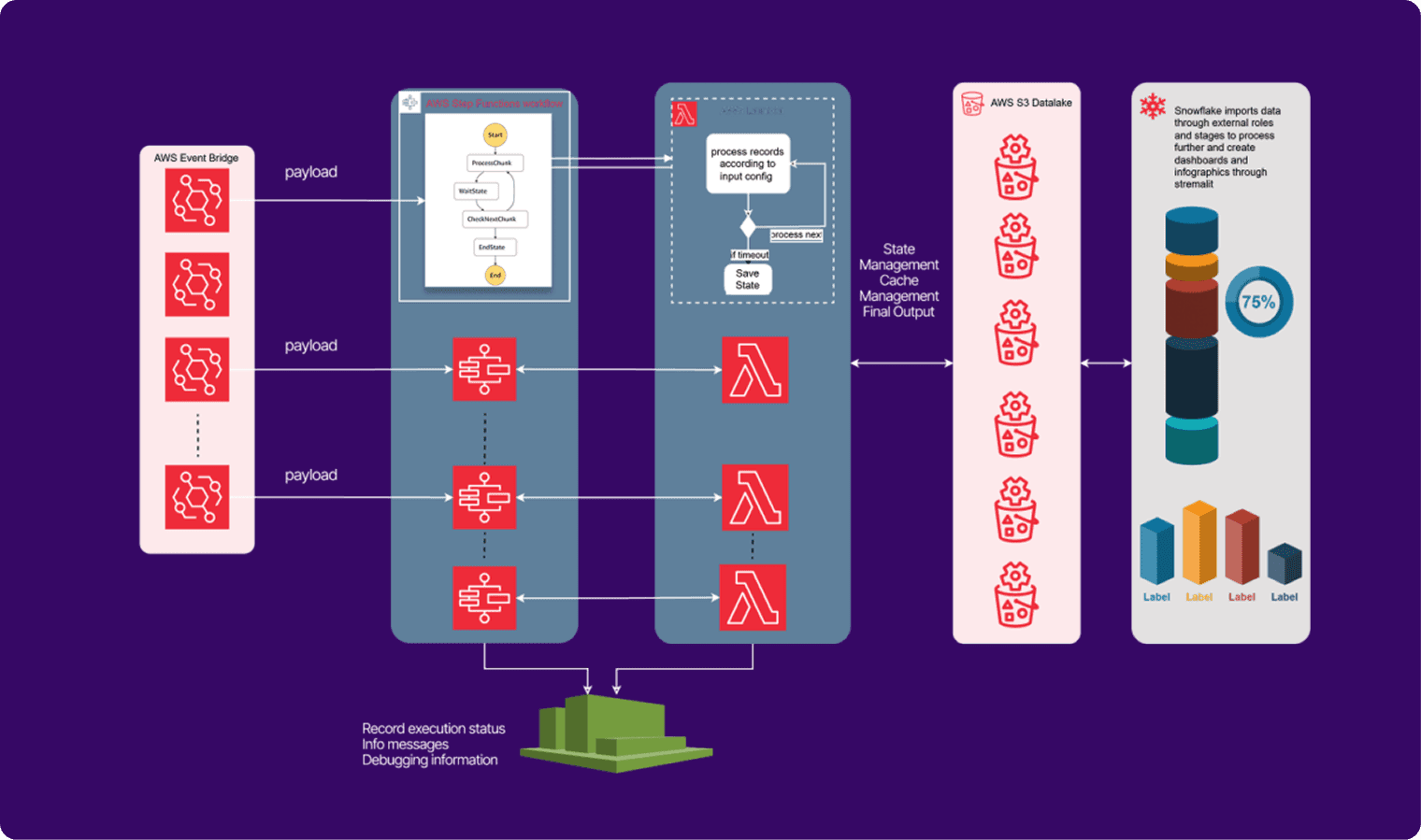
Key Components & Solution
Omax Tech designed and implemented a serverless, event-driven data lake architecture on AWS, optimized for scalability, resilience, and real-time processing.
01
AWS Lambda for Parallel Data Ingestion
Replaced the sequential workflow with thousands of parallel ingestion jobs, dramatically reducing execution time.
02
AWS Step Functions for Orchestration
Managed retries, error handling, and workflow coordination to ensure fault tolerance.
03
AWS Glue for Data Transformation
Standardized diverse menu formats and optimized transformation workflows.
04
Event-Driven Scheduling
Ensured menu data was ingested based on local restaurant time zones, enabling accurate meal categorization.
05
Rate Limiting & Politeness Controls
Implemented request throttling and delays to prevent server overload on host websites.
06
Snowflake for Analytics & Reporting
Enabled fast querying and real-time insights for business users.
Results
90% reduction in execution time Data ingestion reduced from ~72 hours to ~7 hours.
Real-time data availabilityEnabled timely and accurate market analysis.
Highly scalable & resilient system Automatically adapts to workload changes and recovers gracefully from failures.
Improved data accuracyTime zone-aware ingestion increased menu accuracy from ~25% to ~95%.
Conclusion
By leveraging AWS Lambda, Step Functions, EventBridge, AWS Glue, and Snowflake, Omax Tech transformed a fragile, slow, and sequential data pipeline into a scalable, real-time data lake capable of processing data from thousands of restaurant locations efficiently.
The solution delivered significant performance improvements, cost savings, and operational reliability, empowering the client to make smarter, data-driven decisions with confidence. This case study demonstrates how cloud-native, serverless architectures can revolutionize large-scale data ingestion and analytics making systems faster, more resilient, and future-ready.